



Pressure switch
ESQ
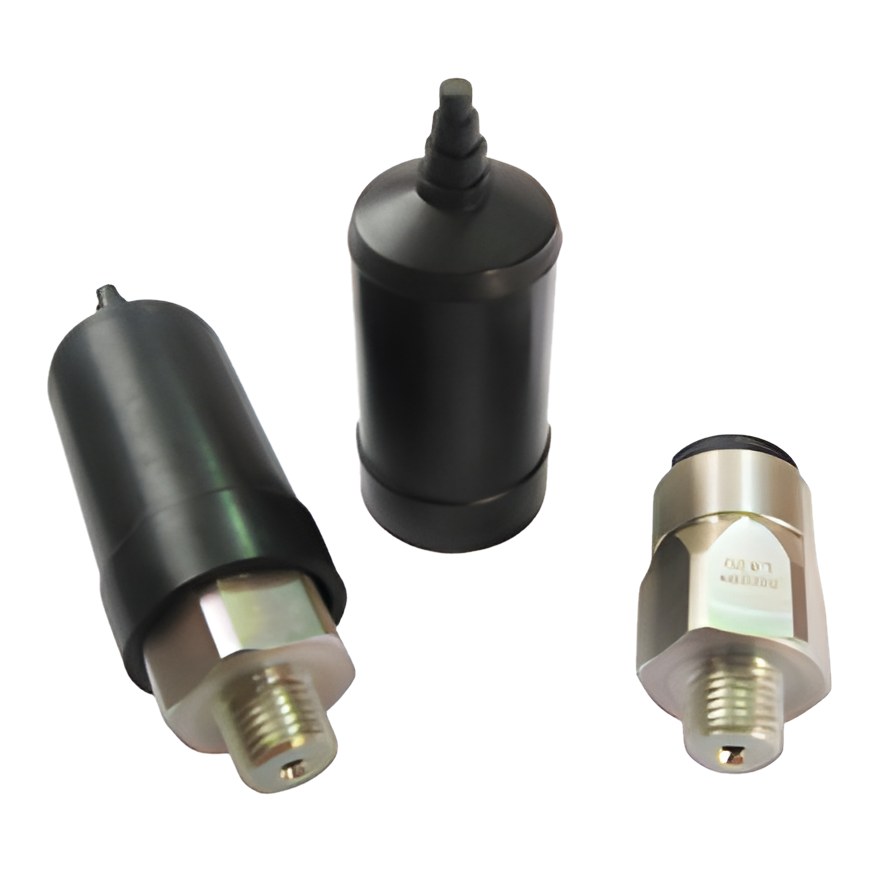
Pressure switch (pressostat) for signalling pressure rise above or drop below a limit, in ranges from 0.2 to 50 bar. The NO/NC contact can be loaded up to 3 A and 300 V.
- Pressure ranges 0.2–1 bar, 1–19 bar and 20–50 bar
- NO/NC contact, max. 3 A and 300 V
- Metal housing, switch protection IP67
- Diaphragms in NBR, Viton, EPDM or silicone
- No display or scale
Description
When the pressure exerted by the medium on the diaphragm of the pressure switch is greater than the set spring force, the contact opens or closes. The contact signal is sent to the system, where it is used for signalling and process control.
Application:
- on machines
- in simple processes
The body is made as HEX 24 or HEX 27 (RoHS), in stainless steel SUS316, bronze or galvanised steel. The standard connection is M10 × 1; 1/8" and 1/4" in NPT, PT and G versions are also available.
The diaphragm material is selected according to temperature: NBR (standard) −30 to 100 °C, Viton −5 to 120 °C, EPDM −30 to 120 °C and silicone −40 to 120 °C. The operating temperature of the switch is −10 to 100 °C.
Technical data
| Type | ESQ |
|---|---|
| Body | HEX 24(ROHS) HEX 27(ROHS) SUS316 Bronze galvanised steel |
| Power supply | 42Vdc, 220Vac |
| Contact | Max. 3A Max 300V |
| Response frequency | 2 Hz |
| Max. surge voltage | 1.5 KV |
| Electrical connection | Terminals and connectors |
| Operating temperature | -10ºC - 100ºC |
| Diaphragm material | NBR (standard) -30ºC-100ºC VITON -5ºC-120ºC EPDM -30ºC-120ºC SILICON -40ºC-120ºC |
| Pressure range | 0.2-1 bar 1-19 bar 20-50 bar |
| Pressure variation | +/-5% |
| Connection | M10x1 (standard) 1/8" NPT, 1/4" NPT 1/8" PT, 1/4" PT 1/8" G, 1/4" G |
| Contact type | NO/NC |
| Body protection | IP00 |
| Pressure switch protection | IP67 with additional protective |
| Service life | 1,00,000 cycles |
| Torque | <0.35Nm |
Help with selection
Describe your application and we will suggest a version and a catalogue number.
For an accurate reply, please state in your enquiry:
- 01The medium and its temperature
- 02Measuring range
- 03Output signal or power supply
- 04Type of mounting and connection